Triumph TR3 Buyers Guide
What to look for in a TR3, TR3A or TR3B today: the rust traps, the chassis and the front suspension, the engine, gearbox and rear axle, the weak points owners and testers found in period, the common modifications, and the numbers that prove a car's identity.
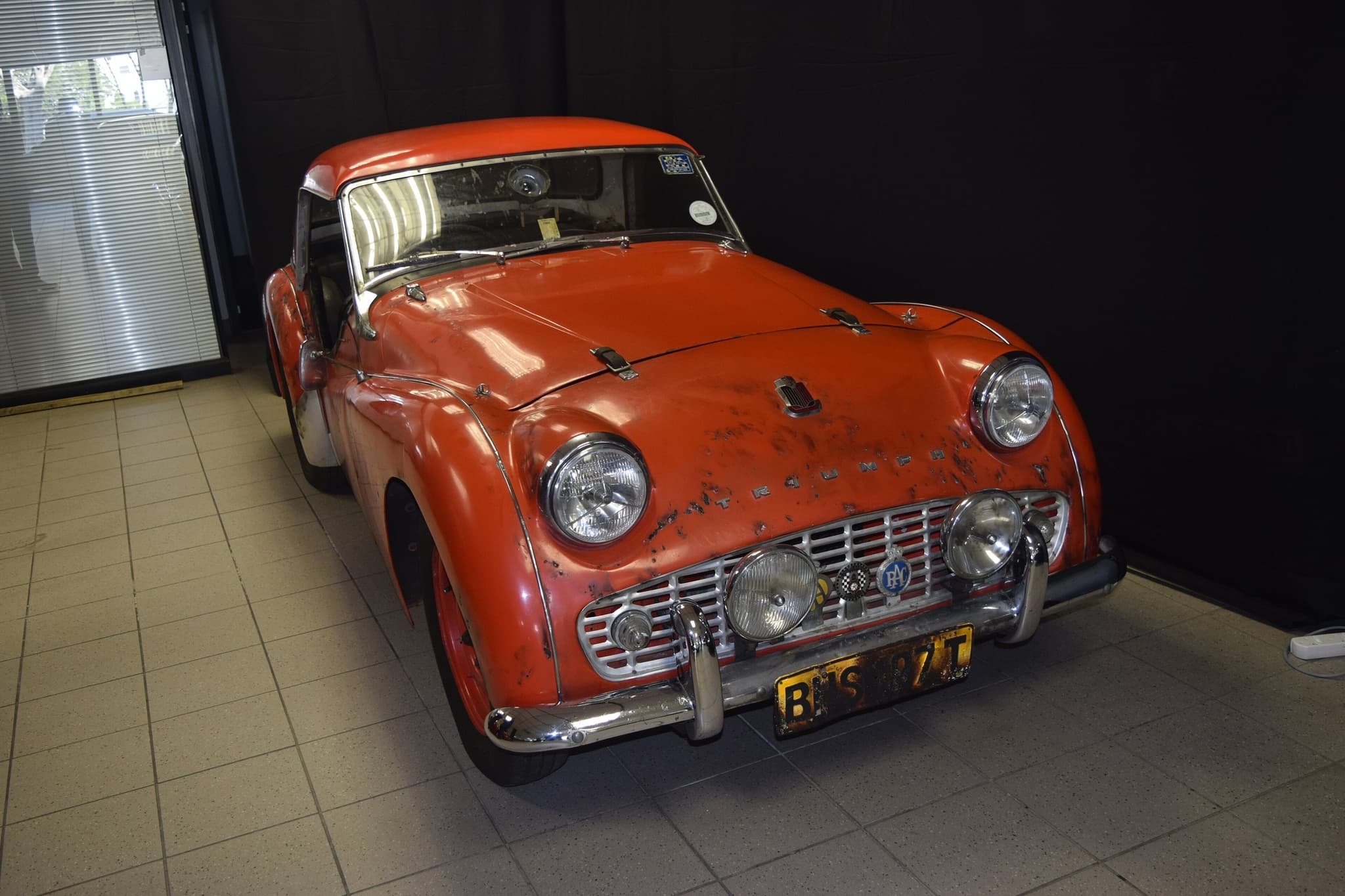
Expect a TR3 to have been taken apart at least once. The TR Register is blunt about it:
Like most cars, all TR's rust, and over the years, many have been partially or totally rebuilt with varying levels of competence.
Bruno Dwinger, writing for the German TR Register in 2008, advised assuming that any TR2 or TR3 for sale had been restored once and might need it again. So the question for a buyer is less whether a car has been rebuilt than how well. The checks below follow the TR Register's general guide and Dwinger's, which between them cover the TR3, TR3A and TR3B; the period weak points come from the tests, the owners and the factory's American service notes.source 1source 2
The checks, in order
The body tells most of the story, and it can be read before the car moves. The chassis needs a lift, and the engine and axle a drive.
Panel fit and wing tops
Sight along each side for ripples and dents, and feel along the tops of the wings (fenders), where rust starts from beneath.
Doors, posts and sills
Open the doors and look at the A and B posts and the wing edges; feel underneath the sills (rocker panels) and the bottoms of the doors.
Panel edges and joints
Check the edges of the bonnet (hood) and boot (trunk) lids. In the boot, look with a torch (flashlight) along the top edge where the wing meets the body; under the bonnet, at the inner panels and around the headlamps and bumper mounts.
Floors and bulkhead
Lift the driver's carpet and look at the joint of the bulkhead on the passenger's side, Dwinger advises, and at the hollow behind each front wheel arch, the panel under the battery and the rear apron below the tail lamps.
The colour under the bonnet
It should be the body colour; black, underseal or another colour there is not original, the TR Register says.
The chassis, on a lift
The front half is usually oily enough to resist rust but takes the knocks; check the outriggers that carry the body, the front horns, the spring turrets and the wishbone mounts, and look for rippling behind the front axle. Look for rust in the rear half.
Front suspension and steering
The trunnions wear when greasing is neglected or the wrong grease used; check the wishbone bushes, the upper ball joints and their gaiters, and the cam-and-lever steering box and idler for play.
The engine
Test the compression and for leaks down the bores; leaks from the water pump, fuel pump, filter or carburettors are not acceptable, though some oil from the rear crankshaft seal is normal unless a lip seal has been fitted. Brown froth under the filler cap can mean a head gasket, or only short trips.
The drive
The temperature should settle in the middle of the gauge. First gear has no synchromesh on a TR3 or TR3A, but the changes should be clean; the overdrive should come in at once and drop the revs by about a fifth; and a gearbox (transmission) noise that stops when the clutch is pressed points to its bearings.
Rear axle and propshaft (driveshaft)
Check the spring bushes, the links to the lever-arm dampers (shock absorbers), the backlash at the differential and the universal joints.
Wire wheels
Look for splines worn to knife edges on the hubs and adaptors, and listen for a clunk on taking off; check every spoke.
Instruments and trim
Original instruments matter: Dwinger wrote in 2008 that some could no longer be bought, and that very high prices were being asked for the fuel gauge with its hanging needle.
Numbers and papers
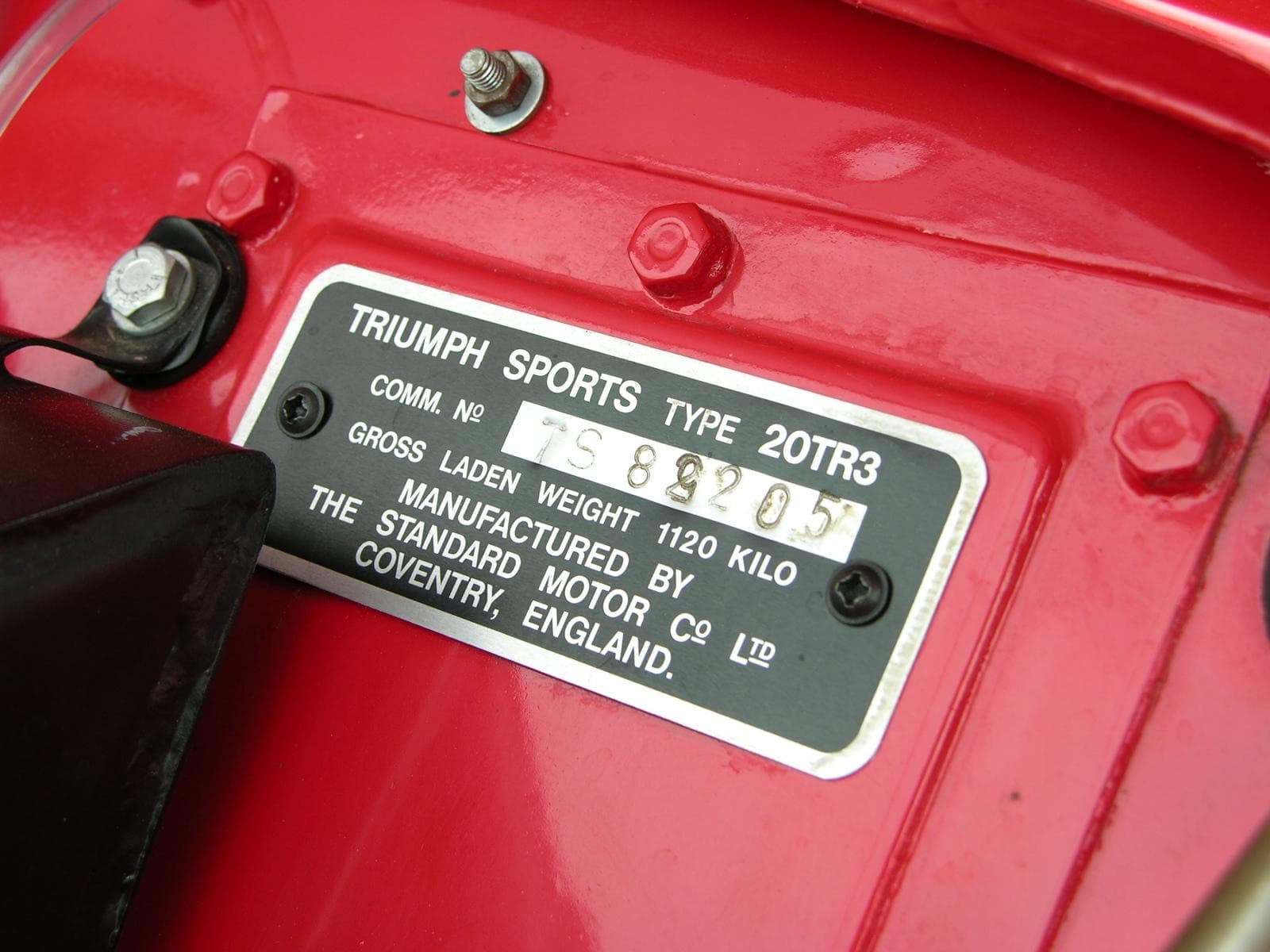
The commission number on the plate must match the registration document; Identification explains the numbers and who can confirm a car's build.
Weak points recorded in period
Some of the faults a buyer looks for now were known when the cars were new. The tests, an owner's letter and the factory's American service notes record these:
| Weak point | What was recorded |
|---|---|
| The rear axle | The Autocar's test car sheared its crown-wheel bolts in 1957, which the magazine thought a one-off |
| Rear wheel bearings | An owner's letter to Motor Sport, 1960, quoted below |
| Grease on the rear brake shoes | In 1962 the American service notes warned that high-pressure grease guns forced grease past the hub seals |
| Overheating on cars of the 1958 and 1959 model years | Air deflectors behind the grille, standard from TS40104 and recommended for earlier cars |
| Dirt on the early disc pads | Dirt shields advised for early disc-brake cars, 1958 |
| Draughts at the sidescreens | Sports Cars Illustrated, in 1957 and 1958 |
| Rust on the fittings | Motor Sport's test car of 1957, by 16,000 km (10,000 miles) |
| Axle wind-up on fast starts | Sports Cars Illustrated and Motor Trend, 1956 |
| A spare-wheel hatch that could not be locked | Motor Trend, 1956, which reported thefts |
| Broken crankshafts in racing | Four of 81 racing owners in an American survey of 1962, two of them on modified engines |
Within 24,000 miles I had two near-side rear wheel bearings go and I understand that this is indeed a weakness of the car.
Modifications and originality
Few TR3s are as they left the factory. Many TR2s have been dressed as TR3s, disc brakes and all, the TR Register warns, and hundreds of TR3As converted to the bigger engine of 1959, which was also a factory option. Dwinger warns of cars rebuilt with later parts, up to the TR4's, and of glass-fibre panels that look like the original steel; of rack-and-pinion steering conversions, which work only with the castor corrected and leave the car no longer original; and of the later J-type overdrive fitted in place of the A-type, which needs a modified mounting on the chassis.
Many TR3s have come back from America to Britain and Europe, the TR Register says, and not all of them lived in dry states. The American cars all left the factory with the wheel on the left, so a right-hand-drive car with an American past has been converted.
Each version has its own points. The drum-braked TR3s, before TS13046, are the earliest. On a TR3A, the body changed at about TS60001, which matters when panels are matched. A TR3B is proved by its number and its gearbox, since nothing on the outside sets it apart from a late TR3A. In 2008 Dwinger found almost every part available, but much of it of poor quality; the supply, then and since, is on Parts.
Sources
Every source the site cites is on the sources page.
- Primarymade at the time, by the maker or by people who were there
- Referenceserious later work: clubs, specialists, magazines, books
- Uncheckedencyclopaedias and enthusiast sites: cited beside a good source, named in the sentence, or marked Unchecked
- TR Register, Buyer's guide pages (group): "Buyer's Guide" (general), "Triumph TR3 Buyers Guide", "Triumph TR3A Buyers Guide", general "Buyer's Guide"; general guide: body, chassis, the colour under the bonnet, the commission number; TR3A guide, the rear of the chassis; TR3 and TR3A guides: conversions; US cars. tr-register.co.uk/resources/buyers-guide Reference
- Bruno Dwinger, "TR 2 bis TR 3 B: Geschichte, Typen und Kaufberatung", TR-Register Deutschland, Nov 2008, 10 pp. (PDF), pp. 5–10, the buying guide; pp. 5–10: body, chassis, suspension, steering, engine, gearbox, overdrive, axle, wheels, instruments; pp. 5–10: later parts, glass-fibre panels, steering and overdrive conversions; the parts in 2008. tr-register.de/wp-content/uploads/2025/10/Kaufberatung_Geschichte_TR2_TR3.pdf Reference
- The Autocar, "The Autocar Road Test No. 1622 — Triumph TR3 Hardtop", 11 Jan 1957, pp. 41–43, the rear axle. trvc.nl/wp-content/uploads/2016/11/road-test-TR-3-1957.pdf Primary
- Motor Sport, "Experience of the Triumph TR" (reader's letter), May 1960, p. 68, p. 68. motorsportmagazine.com/archive/article/may-1960/68/experience-of-the-triumph-tr Primary
- Triumph Sports Owners Association, Triumph Sports Owners Association Newsletter, July 1962, Jul 1962, the service column: grease and the rear hub seals. vintagetriumphregister.org/tsoa/aTSOA0762.pdf Primary
- Triumph Sports Owners Association, Triumph Sports Owners Association Newsletter, April 1959, Apr 1959, the grille deflectors. vintagetriumphregister.org/tsoa/TSOAApril59.pdf Primary
- Triumph Sports Owners Association, Triumph Sports Owners Association Newsletter, May 1960, May 1960 (vol. VI no. 5), p. 6, the grille deflectors. vintagetriumphregister.org/tsoa/TSOA0560.pdf Primary
- Triumph Sports Owners Association, Triumph Sports Owners Association Newsletter, October 1958, Oct 1958, dirt shields. vintagetriumphregister.org/tsoa/TSOAOctober58.pdf Primary
- Triumph Sports Owners Association, Triumph Sports Owners Association Newsletter, December 1958, Dec 1958, dirt shields. vintagetriumphregister.org/tsoa/TSOADecember58.pdf Primary
- Karl Ludvigsen, "Disc Braked TR-3", with the Standard-Triumph advertisement in the same issue, Sports Cars Illustrated, Apr 1957, pp. 16–19, 58, the side curtains. Primary
- Len Griffing, "SCI Road Test — Triumph TR3", with the Standard-Triumph Motor Co. Inc. advertisement in the same issue, Sports Cars Illustrated, Mar 1958, pp. 30–31, 58, the side curtains. Primary
- Bill Boddy ("W. B."), "Triumph TR3 Road-Test", with the data panel "The Triumph TR3 Hard-Top" (p. 14), Motor Sport, Jul 1957, pp. 13–14, rust on the fittings. motorsportmagazine.com/archive/article/july-1957/13/triumph-tr3-road-test Primary
- Karl Ludvigsen, "Triumph gets a going over", Sports Cars Illustrated, Mar 1956, pp. 36–38, 56, axle wind-up. Primary
- "P.S.", "The Triumph TR-3", Motor Trend, Oct 1956, pp. 29, 52, axle wind-up; the spare-wheel hatch. Primary
- Triumph Sports Owners Association, Triumph Sports Owners Association Newsletter, February 1962, Feb 1962, the racing owners' survey. vintagetriumphregister.org/tsoa/aTSOA0262.pdf Primary
- Carl Musson (production dates and numbers) and Ken Streeter (spotter's guide), "TR3 (1955-1962)": the history, "Production Dates and Numbers" and "The TR2-TR3 Series Spotter's Guide", Vintage Triumph Register, "Production Dates and Numbers": about TS60001; the spotter's guide. vintagetriumphregister.org/tr3 Reference
- TR Drivers Club, "Triumph TR3B" (updated March 2015), the TSF and TCF series. trdrivers.com/articles21/triumphtr3b.html Reference
- Wikipedia (EN), "Triumph TR3", 2026, the survival figure, marked "citation needed". en.wikipedia.org/wiki/Triumph_TR3 Unchecked