Triumph TR3 History
From the London Motor Show of October 1955 to the last North American TR3B of 1962: how Standard-Triumph turned the TR2 into a sports car built for export, and kept it selling with disc brakes, a facelift and a bigger engine.
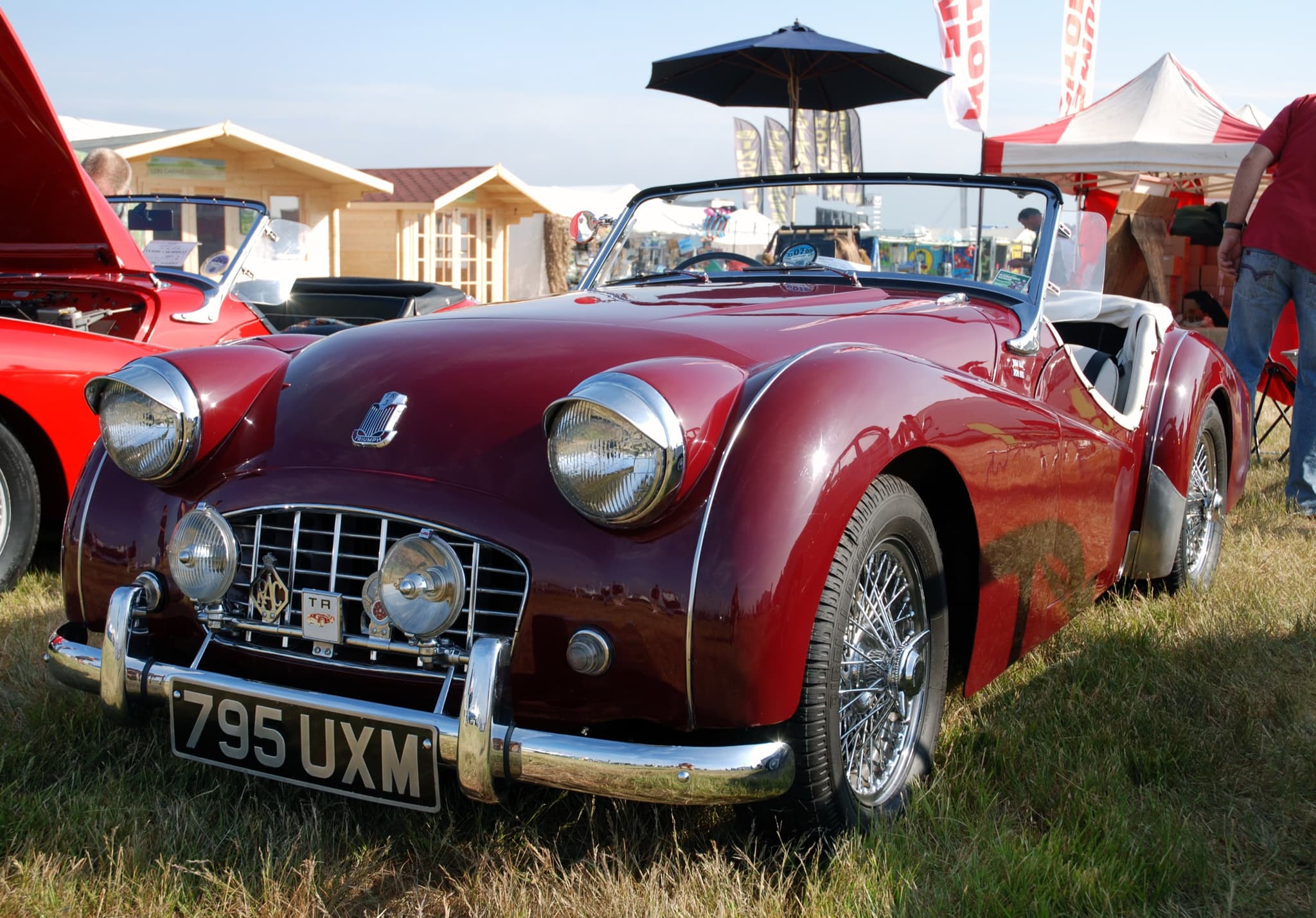
In the summer of 1952, by Karl Ludvigsen's account of 1956, Sir John Black, who ran the Standard Motor Company, came home from a visit to America with a target: "a fast yet cheap sports car for that specific market". The TR2 of 1953 was the first answer. The TR3, shown at the London Motor Show in October 1955, was the second, and for seven years it was built above all for export.
It was never a new car. It was the TR2 improved, then facelifted, then given a bigger engine, and its last version was built for North American dealers in 1962, after its successor, the TR4, had been announced.source 1source 2source 3source 4
Before the TR3: the TR2 and its engine, 1952–55
The TR series began with the 20TS, a prototype sports car shown at Earls Court in October 1952. Ken Richardson was brought in to develop it, and the result was the TR2 of 1953. By the time the TR3 replaced it, Motor Sport could say that the TR2 had "earned a great reputation in sports-car races and rallies without departing very far from standard form".
The engine came from further back. Ted Grinham, Standard's chief engineer, designed a four-cylinder engine with wet cylinder liners that could serve both the Ferguson tractors Standard built and the company's own cars. It went into the tractors from 1947 with an 80 mm bore and into the Vanguard saloon (sedan) in 1948 with an 85 mm bore. The TR used it with a bore of its own, between those two, which Motor Trend explained in 1957: the engine was "a warmed-up refinement of the Standard Vanguard mill with bore decreased through use of thicker wet cylinder liners to bring engine size into a more favorable racing class".
The TR3 arrives, 1955–56
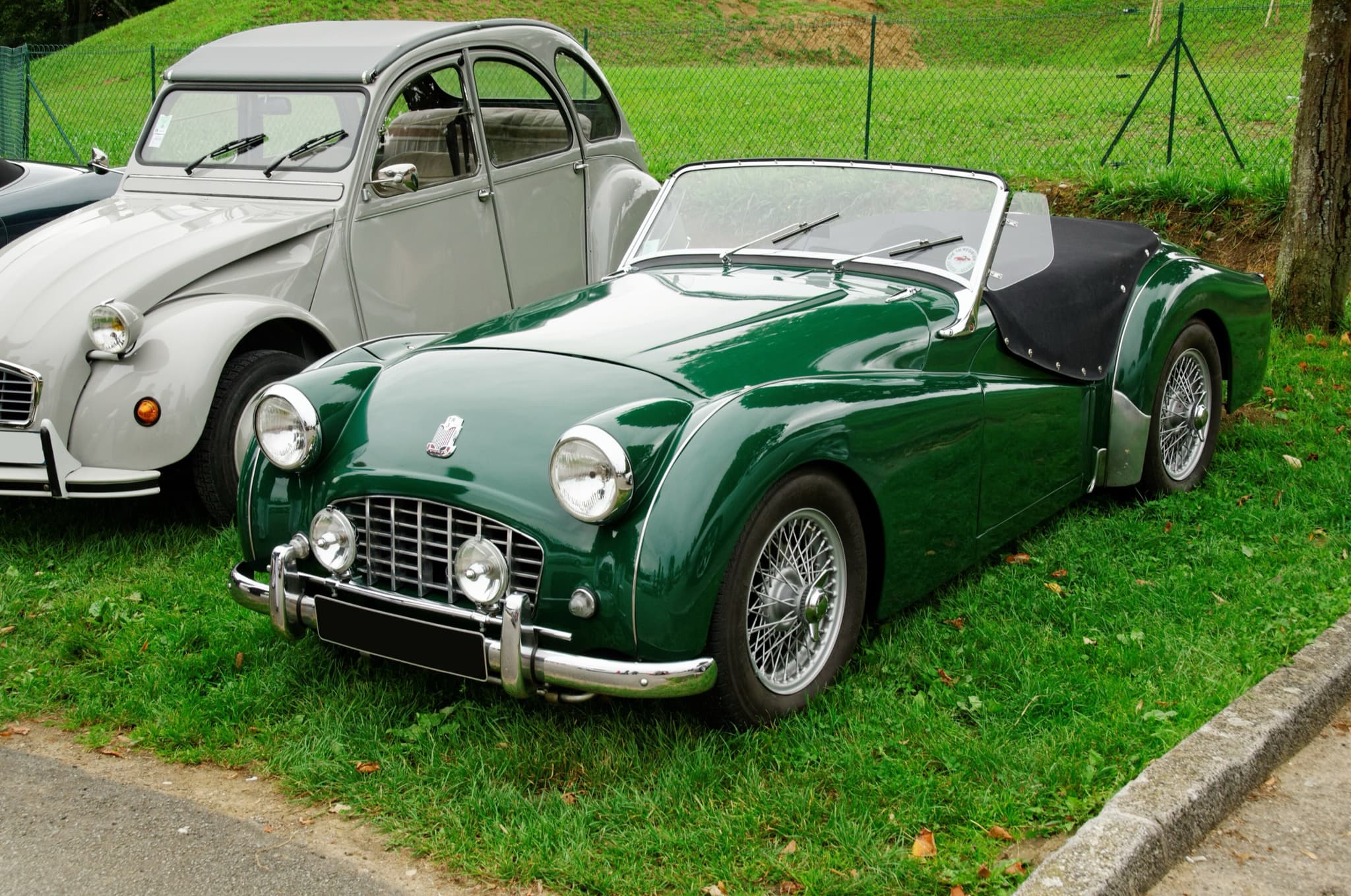
The TR3 was on Triumph's stand, No. 123, at the London Motor Show at Earls Court in October 1955. From outside it was known by its grille, brought forward to the front of the mouth; under the bonnet (hood) there were larger carburettors and more power, and the table near the foot of this page sets out the rest. Motor Sport summed up its price:
The TR3 is priced at £25 more (£650 basic) than the TR2 but at an inclusive price of £921 19s. 2d. in this country, or £985 14s. 2d. in hard-top form with sliding windows, it is right at the top of the sports-car field in terms of value for money.
The first TR3 was TS8637, by the Vintage Triumph Register's list and Dwinger's; Rimmer's catalogue starts its list at TS8709, built on 7 October 1955, as its first production car. Standard-Triumph's American company announced the car that December, and in March 1956 Ludvigsen tested "their first TR3" for Sports Cars Illustrated. Standard had introduced it in London, he wrote, "to supplement the TR2", with the American market in mind; there it cost $100 more.
The power was rated differently on the two sides of the Atlantic. Standard-Triumph's British announcement gave the TR3 5 bhp more than the TR2; its American company quoted a higher figure from the start; and the "high-port" cylinder head fitted from engine TS12606E in mid-1956 brought the British rating up to the American one. No source read explains the difference, and the TR3's page gives each rating with its source.
In September 1956, from commission number TS13046, the TR3 gained Girling disc brakes at the front and a new rear axle. At the London Motor Show that October Motor Sport found the discs "at the unchanged price" and called the TR3 "one of the world's best-selling sports cars". The same show had a transparent TR3 as an exhibit. How the discs worked, and the claims made for them since, are on the TR3's page.source 2source 4source 5source 6source 3source 9source 1source 10source 11
The TR3 in production, 1956–57
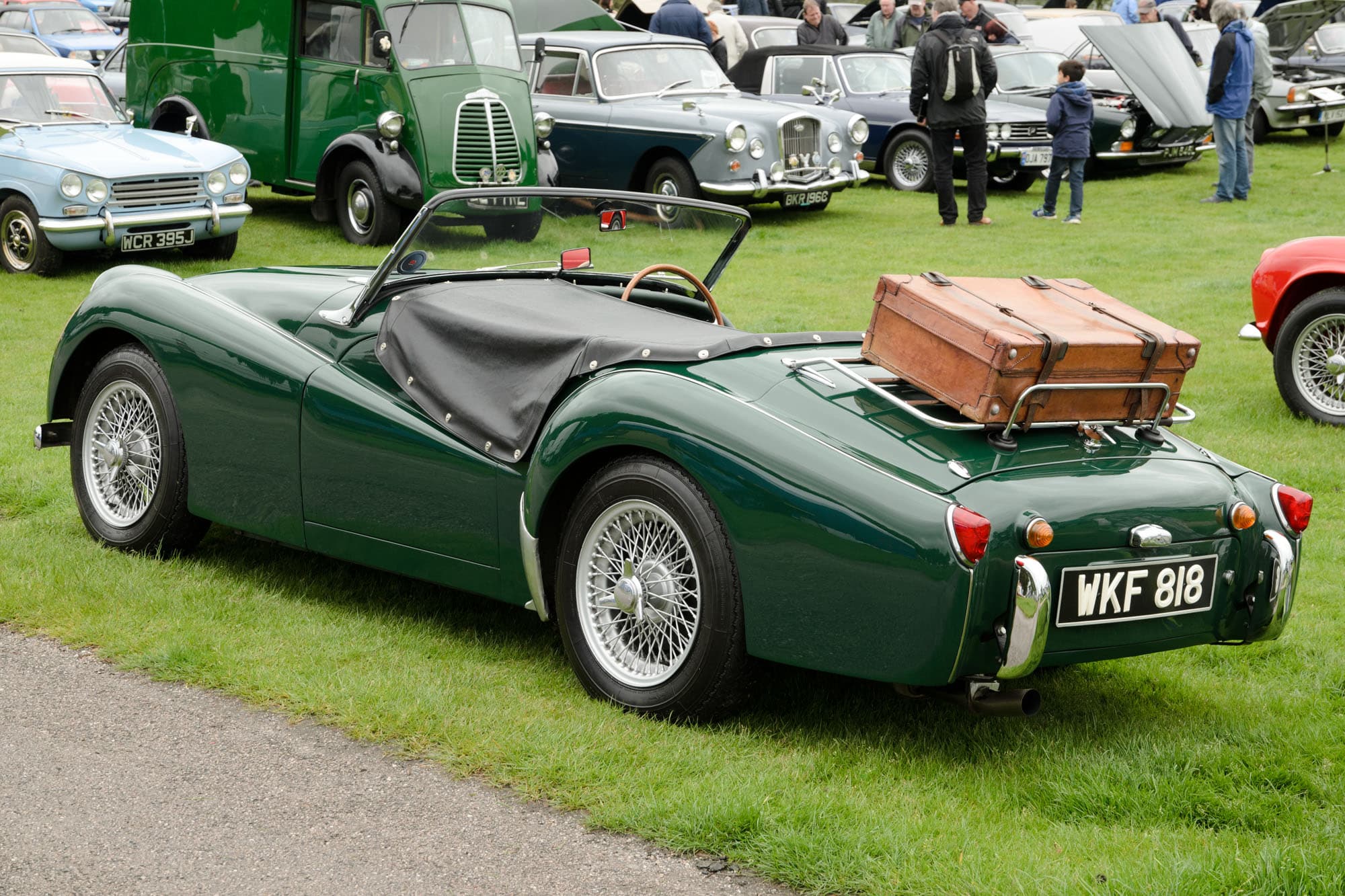
When Motor Sport went round the Canley works in the spring of 1957, TR3 bodies were arriving from Mulliners in Birmingham with their base frames welded in and their seats, screens and upholstery fitted; Standard made the hoods (soft tops), sidescreens and tonneau covers beside the line. The chassis were built on a line at right angles to the bodies, the axles came from Banner Lane and the Girling disc brakes arrived as complete units with their hubs. Every engine was run for about three-quarters of an hour on one of 28 Heenan & Froude test brakes and rejected if it did not "develop 74 b.h.p. or reach 3,500 r.p.m."; every finished car was driven about 32 km (20 miles) on the road.
So popular is the TR3, particularly in America, that 90 per cent. of the output is exported and there is now a three-month delivery delay in this country.
The competition department was in the old Service Department, where Richardson had three mechanics and eight TR3s on his books, besides four Standard Tens. In Britain, Standard's publicity manager, I. J. Penrice, had started a TR Owners' Club; in America the factory club, the Triumph Sports Owners Association, passed 5,000 members by September 1959. From 1957 it ran a "Triumph Rally of Europe", on which Americans flew to London, collected new TR3s at the airport and toured the Continent. Bill Boddy of Motor Sport saw "40 U.S. Triumph enthusiasts" taking delivery there in 1957. How the cars were sold in America is on the export markets page.
The testers liked what they drove. The Autocar tested a hard-top TR3 in Belgium for its issue of 11 January 1957 and admired its flexibility and its brakes, while warning that the back could sometimes slide on poor roads; Boddy, testing one for Motor Sport that summer, praised the disc brakes and found the steering slow to respond; and in America Motor Trend had already judged it good value for the money. Every test is on the road tests page.source 8source 12source 13source 14source 15source 16source 17
The facelift, 1957–58
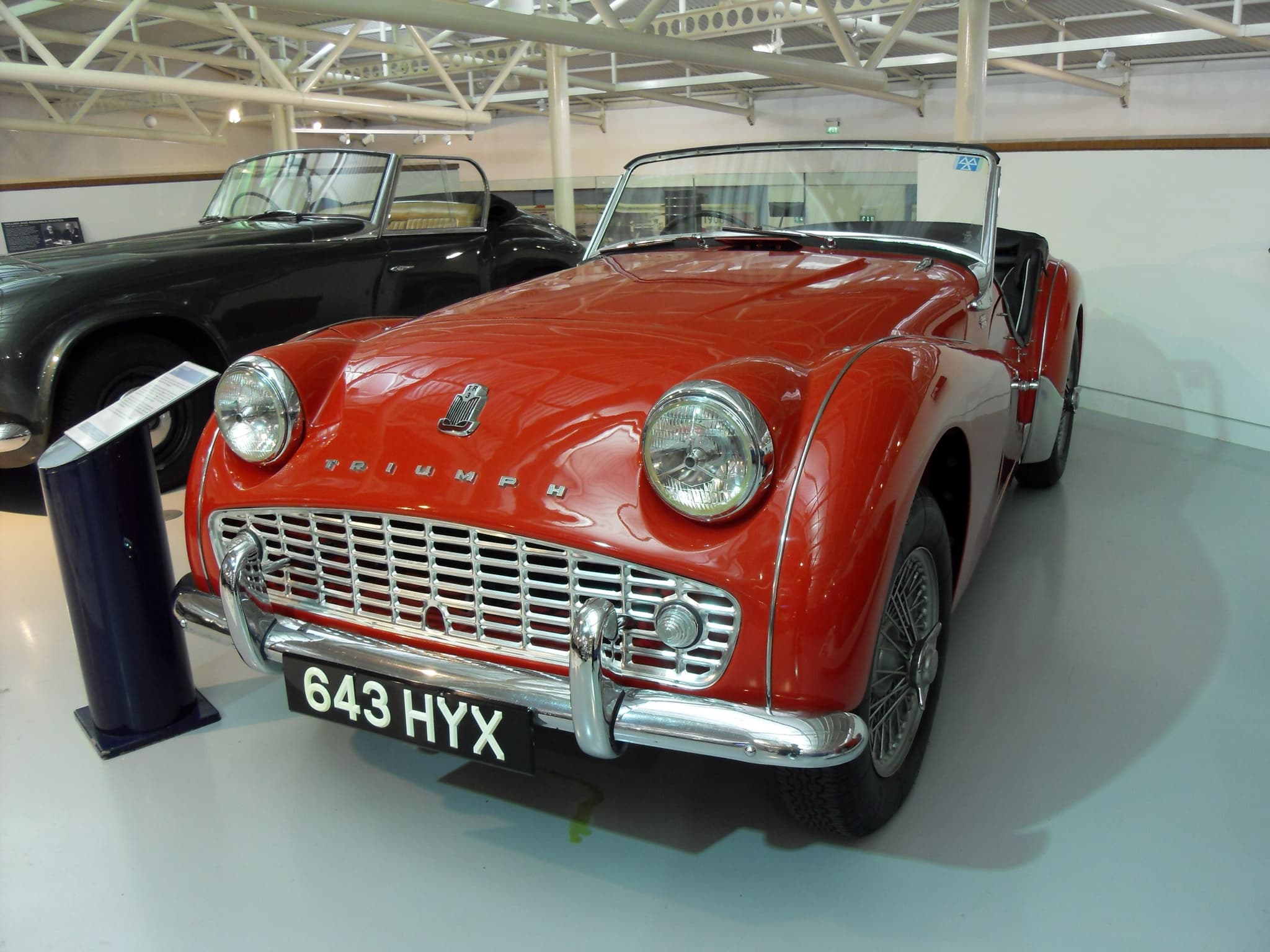
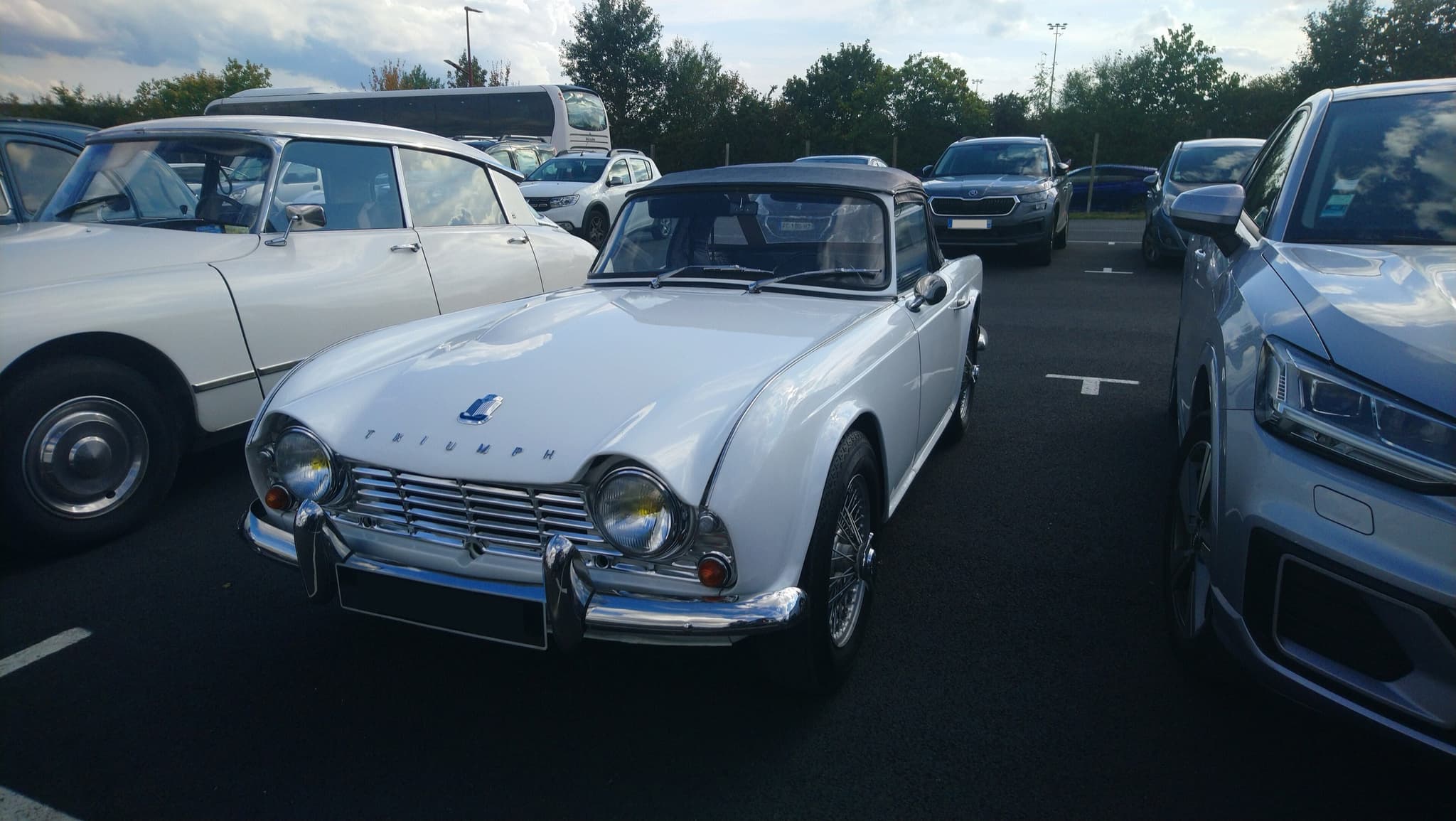
The last TR3 was TS22013, built in August or September 1957 (the Vintage Triumph Register and Rimmer differ), and the facelifted car began at TS22014 that September. It had a full-width grille, recessed "a la Ferrari", as Sports Cars Illustrated put it, outside door handles, overriders (bumper guards) and a boot (trunk) lid with a handle and a lock. Sports Cars Illustrated, testing an American car, also noted smaller headlamp bulges with sealed beams, the name spelled out across the bonnet and a fuller front bumper. Mechanically it was unchanged. The TR Register dates its public launch to January 1958.
No source read gives the factory's reason. G. William Krause credits the full-width grille of Michelotti's TR3 "Dream Car" of 1957 with inspiring it, and Boddy had suggested in July 1957 that new styling would help its sales in the dollar markets; neither is evidence of a decision.
The factory's advertising still called the car the TR-3. The American newsletter announced the facelift in December 1957 as the TR-3 for 1958; a year later its editors were calling the car the TR-3A, and Motor Sport was writing "TR3A" by November 1958. How the name took hold is on the TR3A's page.
America took to it. Standard-Triumph claimed second place in American sports-car sales by the end of 1957 and again for 1958, and in October 1958 its newsletter put TR3 production at 450 a week, up by 100. The works cars kept winning too: a Coupe des Alpes for Keith Ballisat and Alain Bertaut on the 1958 Alpine Rally, and 2nd, 3rd and 5th in the GT class up to 2,000 cc at Sebring (the racing page has every result).source 5source 3source 18source 4source 19source 16source 20source 21source 22source 23source 24source 25
1959–61: the peak, the bigger engine and the end of the TR3A
In November 1958 the American newsletter told owners what to expect of the next year's cars:
Yes, the 59's are out, and they look remarkably like the 58's. Despite frequent rumors to the contrary, the TR-3 will remain the same for 1959
The change for 1959 was under the bonnet. Triumphs on the 1959 Alpine Rally ran in the class above 2,000 cc with "oversize sleeves resulting in a displacement of approximately 2200 cc", and that August the American newsletter promised owners the same in kit form, with a bore a little wider than the standard engine's. The TR Register says the bigger engine was optional from 1959. Motor Sport later called it "developed originally for the Alpine Rally"; it became the TR4's engine.
The TR Register calls 1959 and 1960 the peak production years. At the London Motor Show of 1959 Motor Sport reported that Canley had started a night shift "to cope with the orders for the TR3", and the price at the show was the same a year later. Changes to the body and trim for the 1960 model year followed at about TS60001, among them a windscreen (windshield) held by bolts, though the American newsletter told owners that the car looked no different.
Standard-Triumph itself was in trouble. Its management had failed to present a successor in time, Dwinger writes, and the company ran into financial difficulties; Leyland took it over in 1961 and imposed strict economies, but the TR4 went ahead. By December 1961 the American newsletter was calling Standard-Triumph International "a member of the Leyland group". The TR Register says that TR3A sales "dropped off dramatically in 1961".
When the last TR3A was built is not settled. The Vintage Triumph Register gives TS83572, built in October 1961, and the TR Register and the TR Drivers Club also end production that October; Rimmer gives TS82347, built in January 1962, and Dwinger TS82436, in January 1962. None of them cites a factory record.source 23source 4source 26source 27source 12source 28source 29source 30source 31source 6source 5source 3source 32source 33
The TR3B and the end, 1962
The TR4 was announced in September 1961, and Bill Boddy told Motor Sport's readers where it was going first:
Once the TR4 gets into production it will replace the TR3 but the entire initial production is reserved for the N. American market.
In America the TR3 was not withdrawn: that September the newsletter offered owners TR3s of the 1962 model year with "no waiting list". Why the factory went on with the old car is told two ways. The North American dealers doubted the TR4, by the TR Drivers Club's account, and asked for more TR3s, by Dwinger's; the Vintage Triumph Register points instead to the TR4's disappointing first sales, especially in the USA.
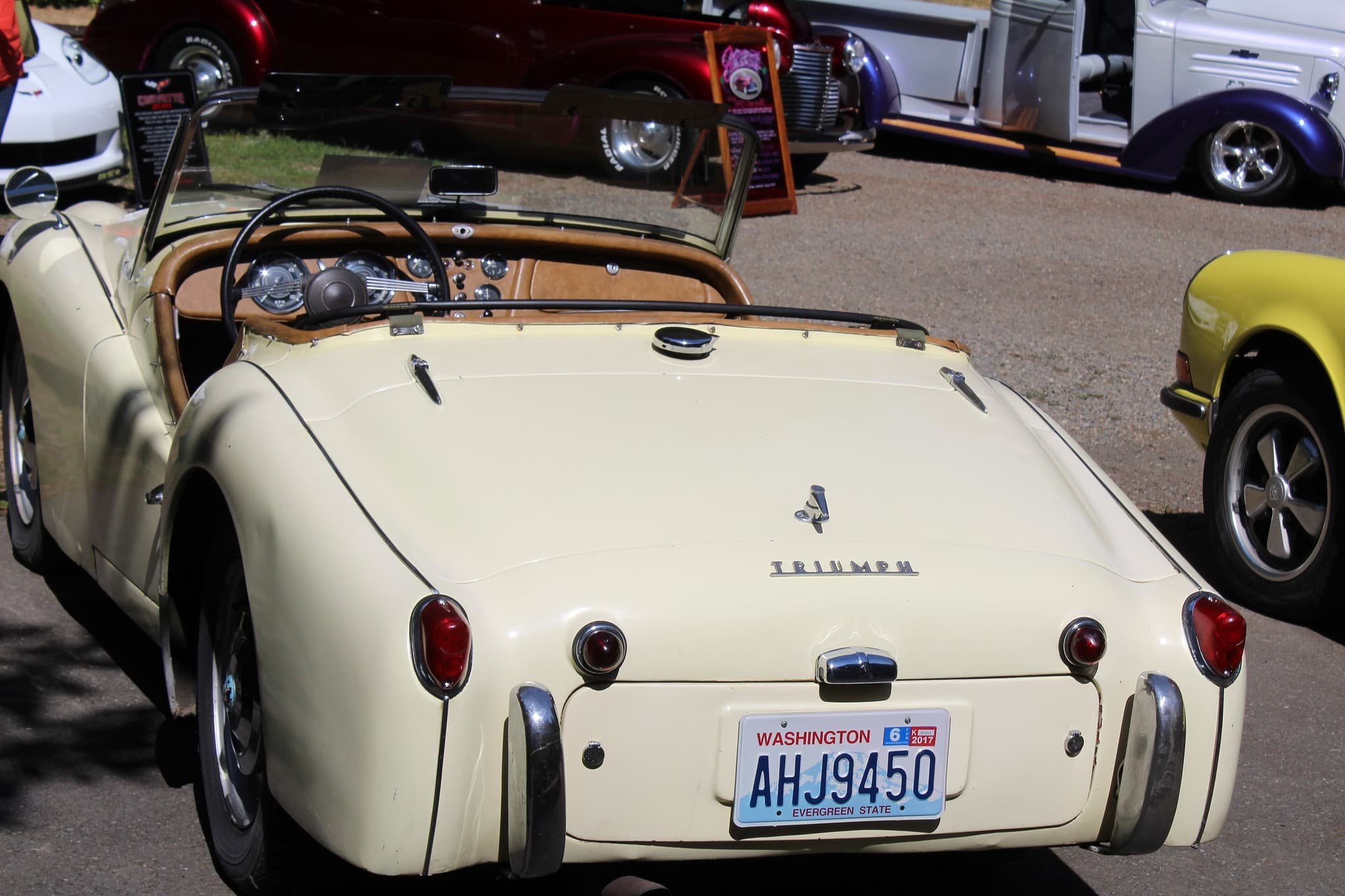
So Standard-Triumph built one more series of sidescreen cars, for North America only. The TR3B was a TR3A with the TR4's all-synchromesh gearbox (transmission): the TSF series, numbered TSF1 to TSF530 and built from March to September 1962, kept the TR3A's engine, and the TCF series, TCF1 to TCF2804, from May 1962, had the TR4's bigger one. It was built in Birmingham, not Canley, by Mulliners' subsidiary the Forward Radiator Company, as Rimmer and the TR Drivers Club record. In the newsletter's issues read, the name "TR-3B" appears once, in August 1962, when an owner had yet to choose between a TR-3B and a TR-4.
The last of them, TCF2804, was built in October 1962 by the Vintage Triumph Register's and the TR Drivers Club's dates, or in December 1962 by Rimmer's; Dwinger gives October in his text and December in his table.source 28source 34source 32source 6source 5source 3source 35
How many were built
The production tables of Rimmer and Dwinger, and the TR Register's for the TR3 and TR3A, count each version separately, and their figures are on the TR3's, the TR3A's and the TR3B's pages, with every other figure in print. Together they come to about 75,000, by our arithmetic. With the TR2 the total is Dwinger's own figure for the four, which our sum matches. Of the TR3s and TR3As, all but a few thousand went abroad.
Two other totals of the time count different things. Motor Sport wrote in September 1961 that over 80,000 TRs of every model had been sold since 1952, nearly 55,000 of them in America; Standard-Triumph that same month spoke of "60,000 TR-3 drivers in the United States", which is more than Motor Sport's figure for every TR sold there. The company's claim gives no basis.source 4source 3source 6source 5source 32source 36source 28source 34
Before and after the TR3
The TR3 began where the TR2 ended, at commission number TS8637, and kept the TR2's chassis, body shell and engine. Motor Trend reported in October 1956 that several changes had been made in answer to owners, among them a softer ride.
| Item | TR2, 1953–55 | TR3, from October 1955 |
|---|---|---|
| Grille | Set deep in the mouth | Egg-crate, nearly flush with the front |
| Carburettors | Twin SUs | Larger twin SUs |
| Overdrive | Optional | Optional, on second, third and top |
| Behind the seats | Less room | More room; an occasional rear seat as an extra |
| Brakes | Lockheed drums | Lockheed drums, then Girling front discs from TS13046 |
The TR4 that followed in September 1961 kept the separate chassis, the wet-liner engine, in its bigger size, and the front disc brakes, and changed almost everything a driver sees and touches: Michelotti's full-width body with wind-up windows, rack-and-pinion steering in place of cam and lever, synchromesh on all four gears and a front track about 100 mm (4 in) wider. The smaller engine stayed available for racing in the class up to 2,000 cc. Car and Driver pointed out that the TR4's gain in power amounted to the difference between a gross rating for the TR3 and a net one for the TR4, and its body from the windscreen back was the same as that of the works team's twin-cam Le Mans cars, the TRS. The World Telegram & Sun, as the American newsletter quoted it, put the TR4 at only about $150 more than a TR3.
TR-3 partisans need not lament the coming of the big 4. It is an addition to the line, not a replacement for the 3.
Between the two came the TR3 Beta, a wide-track TR3 prototype of about 1960 whose purpose is told three ways; and after the TR4's arrival came the TR3B, so that sidescreen TRs were still being built a year after the TR4 was announced.source 5source 2source 1source 17source 28source 37source 38source 39source 32source 40
Sources
Every source the site cites is on the sources page.
- Primarymade at the time, by the maker or by people who were there
- Referenceserious later work: clubs, specialists, magazines, books
- Databaseresults and listings, entry by entry
- Uncheckedencyclopaedias and enthusiast sites: cited beside a good source, named in the sentence, or marked Unchecked
- Karl Ludvigsen, "Triumph gets a going over", Sports Cars Illustrated, Mar 1956, pp. 36–38, 56, p. 36, Sir John Black's target; pp. 36–38; pp. 36–38, the new grille and carburettors. Primary
- Motor Sport, "Sports and high-performance cars at Earls Court", with the list "Sports Cars Costing Under £1,000 Inclusive of P.T.", Nov 1955, p. 16, p. 16, the TR3 at the 1955 show; p. 16, the TR2's reputation; p. 16, Triumph stand 123, and "Sports Cars Costing Under £1,000"; p. 16, Triumph stand 123. motorsportmagazine.com/archive/article/november-1955/16/sports-and-high-performance-cars-at-earls-court Primary
- Graham Robson (essay "15 Years of Evolution"), Triumph TR2 – TR3/3A, TR4/4A – TR5, TR250 1953–1968 Parts & Accessories Catalogue, Rimmer Bros, edn 2.1 (source code TR2512), Part 1, p. 6, "TR Production Figures"; p. 5, Graham Robson's essay "15 Years of Evolution"; p. 7, TS8709 and TS13046; p. 7, TS22013 and TS22014; p. 7, TS82347; pp. 6–7, Birmingham; TSF and TCF dates. rimmerbros.com/images/PDFs/TR2-5_Part1.pdf Reference
- TR Register, Buyer's guide pages (group): "Buyer's Guide" (general), "Triumph TR3 Buyers Guide", "Triumph TR3A Buyers Guide", TR3 and TR3A production tables, home and export; TR3 guide, "Manufactured"; the high-port head; TR3A guide, the public launch; TR3A guide: the larger engine; the peak years; 1961; TR3 and TR3A production tables. tr-register.co.uk/resources/buyers-guide Reference
- Carl Musson (production dates and numbers) and Ken Streeter (spotter's guide), "TR3 (1955-1962)": the history, "Production Dates and Numbers" and "The TR2-TR3 Series Spotter's Guide", Vintage Triumph Register, the history: the 20TS and the TR2; "Production Dates and Numbers": TS8637, TS12606E, TS13046; "Production Dates and Numbers": TS22013 and TS22014; "Production Dates and Numbers": about TS60001; TS83572; the spotter's guide; "Production Dates and Numbers": TSF and TCF; the spotter's guide; "Production Dates and Numbers": TS8636 and TS8637. vintagetriumphregister.org/tr3 Reference
- Bruno Dwinger, "TR 2 bis TR 3 B: Geschichte, Typen und Kaufberatung", TR-Register Deutschland, Nov 2008, 10 pp. (PDF), pp. 1–2, the engine's origins and the tractor bores; p. 3, the commission-number table; p. 2, Leyland; p. 3, TS82436; pp. 2–4, the TR3B; p. 3, the production table. tr-register.de/wp-content/uploads/2025/10/Kaufberatung_Geschichte_TR2_TR3.pdf Reference
- Wayne Thoms, "Triumph TR-3" (An MT Research Report), Motor Trend, Sep 1957, p. 36ff, p. 36ff, the engine. Primary
- Bill Boddy, "Sports Cars of the 'Big Five'", Motor Sport, May 1957, p. 15, p. 15, the daily output; p. 15, the Canley visit and the competition department. motorsportmagazine.com/archive/article/may-1957/15/sports-cars-of-the-big-five Primary
- Triumph Sports Owners Association, Triumph Sports Owners Association Newsletter, December 1955, Dec 1955 (vol. I no. 9), the US announcement. vintagetriumphregister.org/tsoa/TSOADec1955.pdf Primary
- Motor Sport, "The cars at Earls Court", Nov 1956, p. 14, p. 14, Triumph stand 165. motorsportmagazine.com/archive/article/november-1956/14/cars-earls-court Primary
- Motor Sport, "Earls Court impressions", Nov 1956, p. 39, p. 39, the transparent TR3. motorsportmagazine.com/archive/article/november-1956/39/earls-court-impressions-6 Primary
- Triumph Sports Owners Association, Triumph Sports Owners Association Newsletter, September 1959, Sep 1959, membership; the kit's bore corrected. vintagetriumphregister.org/tsoa/TSOASeptember1959.pdf Primary
- Triumph Sports Owners Association, Triumph Sports Owners Association Newsletter, January 1957, Jan 1957, the Triumph Rally of Europe. vintagetriumphregister.org/tsoa/TSOAJan1957.pdf Primary
- Bill Boddy, "My Year's Motoring", Motor Sport, Jan 1958, p. 11, p. 11, London Airport. motorsportmagazine.com/archive/article/january-1958/11/my-years-motoring Primary
- The Autocar, "The Autocar Road Test No. 1622 — Triumph TR3 Hardtop", 11 Jan 1957, pp. 41–43, pp. 41–43. trvc.nl/wp-content/uploads/2016/11/road-test-TR-3-1957.pdf Primary
- Bill Boddy ("W. B."), "Triumph TR3 Road-Test", with the data panel "The Triumph TR3 Hard-Top" (p. 14), Motor Sport, Jul 1957, pp. 13–14, pp. 13–14; p. 13, the closing paragraph. motorsportmagazine.com/archive/article/july-1957/13/triumph-tr3-road-test Primary
- "P.S.", "The Triumph TR-3", Motor Trend, Oct 1956, pp. 29, 52, pp. 29, 52; p. 29, the owners' comments. Primary
- Len Griffing, "SCI Road Test — Triumph TR3", with the Standard-Triumph Motor Co. Inc. advertisement in the same issue, Sports Cars Illustrated, Mar 1958, pp. 30–31, 58, pp. 30–31. Primary
- G. William Krause, The Illustrated History of Triumph Sports and Racing Cars, CarTech, 2017, ch. 3, the TR3 Dream Car's grille. static.summitracing.com/global/images/technicalarticles/sad-ct596.pdf Reference
- Triumph Sports Owners Association, Triumph Sports Owners Association Newsletter, December 1957, Dec 1957 (vol. III no. 12), p. 1, the face-lift for 1958. vintagetriumphregister.org/tsoa/TSOADec1957.pdf Primary
- Motor Sport, "The Cars at Earls Court", Nov 1958, p. 22, p. 22, Triumph stand 135. motorsportmagazine.com/archive/article/november-1958/22/cars-earls-court Primary
- Triumph Sports Owners Association, Triumph Sports Owners Association Newsletter, October 1958, Oct 1958, sales and production. vintagetriumphregister.org/tsoa/TSOAOctober58.pdf Primary
- Triumph Sports Owners Association, Triumph Sports Owners Association Newsletter, November 1958, Nov 1958, second place in 1958; p. 1. vintagetriumphregister.org/tsoa/TSOANovember58.pdf Primary
- Triumph Sports Owners Association, Triumph Sports Owners Association Newsletter, July 1958, Jul 1958 (vol. IV no. 7), the 1958 Alpine Rally. vintagetriumphregister.org/tsoa/TSOAJuly58.pdf Primary
- racingsportscars.com, Sebring 12 Hours 1958, results, GT 2.0 class. racingsportscars.com/results/Sebring-1958-03-22.html Database
- Triumph Sports Owners Association, Triumph Sports Owners Association Newsletter, July 1959, Jul 1959 (vol. V no. 7), the Alpine Rally cars' oversize sleeves. vintagetriumphregister.org/tsoa/TSOAJuly59.pdf Primary
- Triumph Sports Owners Association, Triumph Sports Owners Association Newsletter, August 1959, Aug 1959, "BIG BORE KIT TO BE AVAILABLE". vintagetriumphregister.org/tsoa/TSOAAug1959.pdf Primary
- Bill Boddy ("W. B."), "The new Triumph TR4", Motor Sport, Sep 1961, p. 17, p. 17, the engine's origin; p. 17; p. 17, para. 1. motorsportmagazine.com/archive/article/september-1961/17/the-new-triumph-tr4 Primary
- Motor Sport, "Earls Court Reviewed", Nov 1959, p. 39, p. 39, the Triumph stand. motorsportmagazine.com/archive/article/november-1959/39/earls-court-reviewed Primary
- Motor Sport, "Open sports cars", Nov 1960, p. 36, p. 36, the Triumph price. motorsportmagazine.com/archive/article/november-1960/36/open-sports-cars Primary
- Triumph Sports Owners Association, Triumph Sports Owners Association Newsletter, January 1960, Jan 1960, p. 3, the 1960 model year. vintagetriumphregister.org/tsoa/TSOAJanuary1960.pdf Primary
- TR Drivers Club, "Triumph TR3B" (updated March 2015), the last TR3A "in the previous October"; the dealers; the Forward Radiator Company; the series; the TR3B count; the TR3 Beta, March 2015 update. trdrivers.com/articles21/triumphtr3b.html Reference
- Triumph Sports Owners Association, Triumph Sports Owners Association Newsletter, December 1961, Dec 1961, "a member of the Leyland group". vintagetriumphregister.org/tsoa/aTSOA1261.pdf Primary
- Triumph Sports Owners Association, Triumph Sports Owners Association Newsletter, September 1961 (TR-4 special issue), Sep 1961 (vol. VII no. 9), 1962 TR3s on sale; p. 1, the company's message. vintagetriumphregister.org/tsoa/TSOASep61.pdf Primary
- Triumph Sports Owners Association, Triumph Sports Owners Association Newsletter, August 1962, Aug 1962, p. 2, "TR-3B". vintagetriumphregister.org/tsoa/TSOAAug62.pdf Primary
- Wikipedia (EN), "Triumph TR3", 2026, infobox, "approximately 74,800", citing Harvey (1983). en.wikipedia.org/wiki/Triumph_TR3 Unchecked
- Dennis May, "Technical Report" on the TR-4 (cover story), Car and Driver, Oct 1961, pp. 19–23, pp. 19–23, the TR-3 comparisons. Primary
- Triumph Sports Owners Association, Triumph Sports Owners Association Newsletter, February 1962, Feb 1962, the TR-4's smaller-engine option. vintagetriumphregister.org/tsoa/aTSOA0262.pdf Primary
- Triumph Sports Owners Association, Triumph Sports Owners Association Newsletter, November 1961, Nov 1961, pp. 1–2, the *World Telegram & Sun* on the price. vintagetriumphregister.org/tsoa/aTSOA1161.pdf Primary
- Revington TR, TR3 Beta pages (group): "BETA Prototype", information sheet IS0060, "Triumph Beta prototype 917HP rebuild", "BETA Prototype". revingtontr.com Reference